BhuCarbon
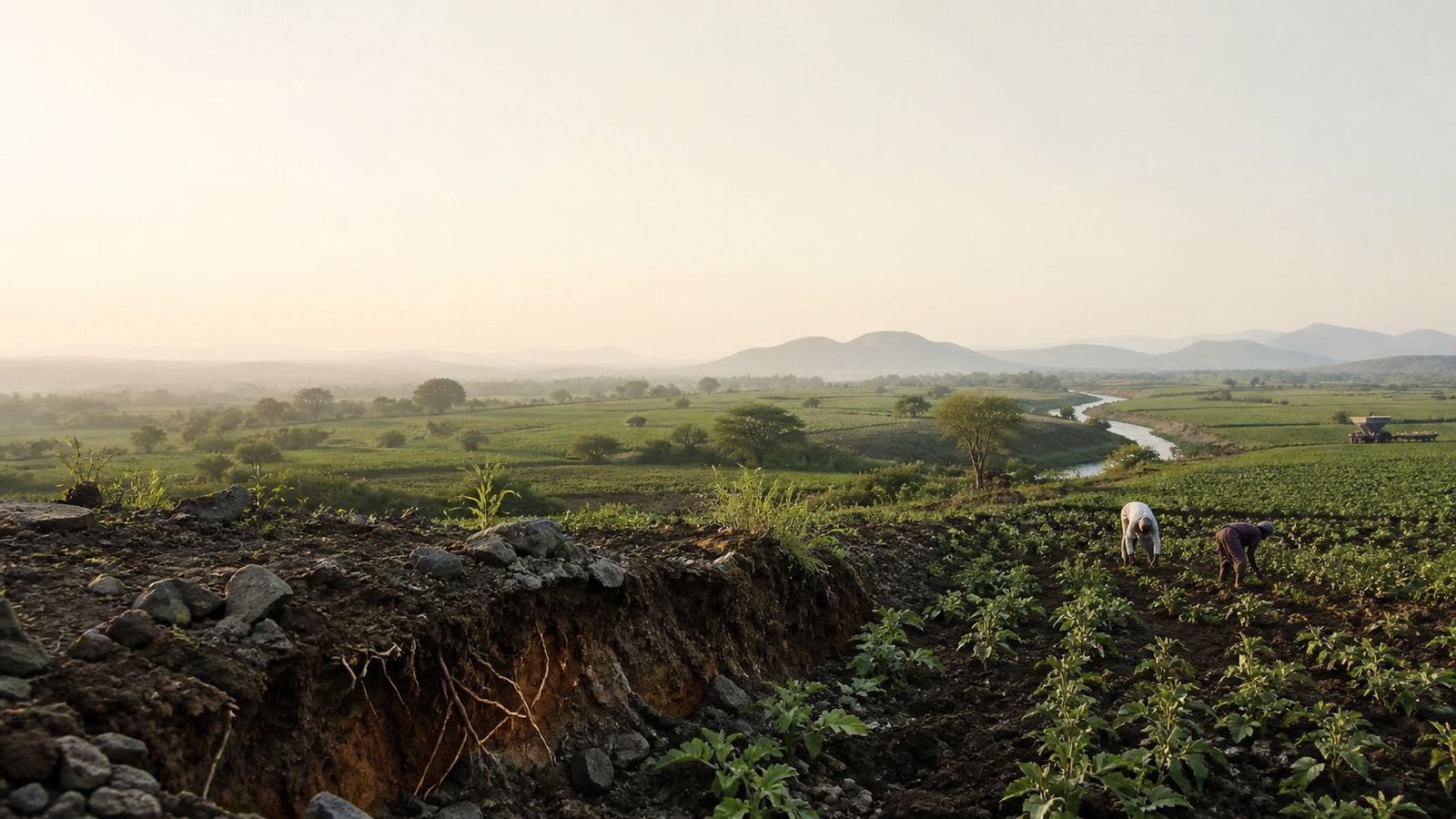
Farmland at first light. In the foreground a cut bank exposes the soil profile in section — dark tilled topsoil over reddish subsoil, threaded with roots and studded with weathered basalt cobbles. Two farmers work a row crop on the right; beyond them the fields flatten out to a river meandering between hills.

About

Bhu — earth, soil, ground.

The name is the whole argument. Carbon removal that does not leave the soil better is not a business a farmer has any reason to join, and a soil programme that cannot prove its removal is not one a buyer has any reason to fund. Both have to hold.

What we are doing

A long programme, started properly.

Bhu Carbon removes atmospheric CO₂ through enhanced rock weathering on Indian farmland. Finely crushed basalt is spread on cultivated land, where it weathers and converts dissolved CO₂ into bicarbonate — permanently, on a geological timescale — while correcting acidity and returning nutrients to the soil.

We are early. Rather than open with ambition, this site opens with method: what we measure, how the measurement is kept honest, and where the approach is difficult. Those are the things that can be judged today, and they are the things that determine whether anything claimed later is worth believing.

The farmers we work with are smallholders. That shapes every decision — the application has to fit an existing season, the soil card has to arrive in Hindi and in a format already familiar, and the reason to take part has to be visible in the field, not only in a registry.

The team

Our Leadership

  • Shaifullah

    CEO · Sr. Geochemist

    LinkedIn profile for Shaifullah (opens in a new tab)
    Leads the company and the science function — what gets measured and why, the model equations and their parameters, sampling design, and how a registry protocol is read. The scientific question is settled here before anything is built to answer it.
  • Biswajit Panda

    Sr. Geochemist

    Environmental geochemist. His doctoral work at the Indian Institute of Science traced estuarine mixing through strontium isotopes. He has since built the analytical workflows and quality control behind carbon-removal verification. Both are the same problem: proving where a signal came from.
  • Nihal-ud-din

    Technology Lead

    LinkedIn profile for Nihal-ud-din (opens in a new tab)
    Owns the technology function end to end — data capture, the measurement pipeline, versioning, and reproducibility. Works to a single rule: any number this company publishes must be re-computable from its original inputs, on demand, years later, by someone else.

Further team profiles are being added. Nothing appears on this page until the person it describes has confirmed it.

How we work

Science owns the question. Technology owns the record.

Most of what goes wrong in carbon removal software goes wrong at the seam between the people who define a measurement and the people who implement it. So the seam is written down, and both sides are held to it.

Division of ownership between the science and technology functions.
Science owns Technology owns Shared
What is measured, and why Capture, storage, versioning The data schema — science defines the fields, technology defines types and constraints
Model equations and parameters Model execution, reproducibility, scale The model registry, and the discipline of versioning it
Sampling design intent Sampling logistics and optimisation tooling Uncertainty quantification
Interpretation of registry protocol Evidence package generation Audit readiness

Two rules keep it from eroding. Any change to a field schema requires a written note explaining it, because you cannot go back and re-collect last season's soil sample — a one-page document is inexpensive insurance against an expensive irreversibility. And the scientific models live in one place, authored by the scientists, and are executed rather than reimplemented. A model that exists in two copies has one wrong copy and no way to tell which.

Careers

We hire slowly and specifically.

There is no listings page yet. If you work on soil science, geochemistry, MRV, or the kind of data infrastructure that has to survive an audit, write to us and say what you would want to own.